15 November 2012

Lots going on in the worker co-operative world

I've not written a blog for ages due to the small matter of hosting the Global Co-operatives United event and getting The Worker Co-operative Code ready to be published tomorrow to coincides with Global Worker Cooperative Day. It's a busy time for worker co-operatives and it seems like there is lots going on. So here are few things you might be interested in and lets see how we can make ourselves an even more stronger network of co-operative businesses.

The worker co-op code, tools and resources
Want a copy? Co-operatives UK is printing 3000 copies of The Code so hopefully everyone working for a worker co-op member of ours should see a copy and be able to check how they are doing as a business and as co-operative. 

It can be found here: www.uk.coop/workercode but you can also fill in an on-line self assessment tool. In the future this tool will also suggest resources to help you improve your score. At the moment though this is empty, we have no resources! So if you have any resources to share with other worker co-operatives like: Member job descriptions or agreements, Induction material, pay and benefits policies, conflict resolution processes etc please send them to me so we can upload them to the website and build a shared bank of resources.

The previous version was translated into: Japanese, Korean, Maltese, Spanish, Swedish, so if anyone fancies translating this new version, please let me know.
 
Round table event at Co-operative Web Friday, 30th November.
If you are interested in learning best practice from other successful worker co-operatives, we are holding a small round table event from 11.00 till 13.00 in Birmingham for members of Co-operatives UK. 

Co-operative Web will present on their recent growth and how they incorporated new members into the business through a recent acquisition. Members will then have the opportunity to ask questions and more importantly share their own experience and best practice on the topic. This is a great opportunity to network, so if your interested in attending let me know

Research to find out demand for 'Co-operative Skills' training
Having trouble co-operating within your worker co-op? We're exploring different approaches to supporting our members in relation to improving: soft/inter-personal or you could say "co-operative skills". Such as: communication, decision-making, meeting together, dealing with conflict, group dynamics and so on. By filling in this survey you will help us find the evidence to propose better ways of delivering support and training to our members.

Worker co-op newsletter
Britta Werner, of Unicorn Grocery and Board member of Co-operatives UK wants to set-up a regular newsletter for worker co-operatives, so we can share information like: events, jobs, resources, good news stories. If you want to be on the mailing list, contribute or just have some good news to share email us.

Facebook Group
If your the facebook type, we have a group for worker co-operatives with over 60 members, join the conversation and see how you can benefit. I know most Unicorn Grocery and Essential Trading are recruiting at the moment.

Finally thoughts
There is loads going on in the worker co-operative world, and there is probably so much more I don't know about. The worker co-operative council at Co-operatives UK wrote and are trying to deliver on a plan to grow the worker co-op sector, but we need your help (it's really you helping yourself) The worker co-operative economy needs you!Oh and if your not a member of Co-operatives UK, why not, join us!


26 September 2012

The worker co-operative economy needs you!

I have not done a blog for far too long so apologies! The worker co-operative council of Co-operatives UK recently met and wanted to share with members some of their work and actions to grow the worker co-operative sector. They would like your input and more importantly action to help.

In case you don't know the Council meets four times a year and is made up of seven elected members from worker co-ops, and two other (currently and co-operative development adviser and a member of the woodcraft folk).

As well as practical things like attending events/networking, advocating for worker co-ops, helping update the Worker Co-operative Code, they also act as a sounding board for and set priorities in relation to worker co-operatives. Two of the Council members then represent worker co-operatives on our main Board of Director of Co-operatives UK.


At our last meeting members decided  to publish the below working document that sets out priorities and actions for the future to help grow the worker co-operative economy. They would like to invite you to a help suggest and achieve these actions.

The google doc version is here.

Finally here is a blatant plug for Co-operatives United a international festival of co-operatives taking place in Manchester on the 31 Oct to the 2 Nov. A great opportunity to mix with other worker co-operatives from the UK and around the world. Parts are free and parts are paid for so please do come if you can.

20 June 2012

New guide for setting up grass routes worker co-operative


It's been years in the making, Radical Routes a UK-wide network of radical housing and workers' co-operatives has updated their guide to starting and developing workers' co-operatives. 

I heavily promoted the last version, but in recent years, as with all guides it became out dated. The Seeds for Change collective with help from all over the movement (I know our own legal team helped with draft versions) has updated and expanded the guide, which is now three times bigger. It includes information on new kinds of co-operatives and legal structures and more information about finance, flat management structures and co-operative working methods.

Kayleigh Robertson, of the editorial collective, said “In the current economic climate more and more people are creating their own opportunities by setting up workers' co-ops. We really want to facilitate this and inspire a new generation of co-operators to create work without bosses.”
As more people are faced with the economic hardship and the inequity of modern corporate businesses, more are choosing to set-up or become part of co-operatively owned and controlled businesses.


At Co-operatives UK we are getting more enquires all the time about starting new  co-operative businesses and I'm sure our soon to be released state of the co-operative economy report will agree that our movement is thriving. 
 
The books are available to download free here and print versions are £4.50, with a special launch price of £3.50 at Futures North.

If you are thinking of setting up or want to find out about all types of co-operative businesses check out Co-opertives UK's website: www.uk.coop/start

28 May 2012

Worker Co-operative Council Election Results 2012

Thank you to all those members who voted in the worker co-operative council elections for 2012. We can now publish the results:

Bob Cannell 267 First
Alison Banton 189 Second
Sion Whellens 180 Third
Lyn Hope 176
Chris Tomlinson 161
Steve Dixon 1

Turnout for the elections was 25% of the eligible members.  

Congratulation to Bob, Alison and Sion; 

For those that don't know, the worker co-operative council is an official committee of Co-operatives UK. It acts as a sounding board for issues affecting worker co-operatives and in turn nominates two places to the main Co-operatives UK Board of Directors. The Council isn't just a talking shop and either influences or directly take action on behalf of worker co-operatives.  Here is a link to their most recent strategy plan.

Currently the Council is made up of  7 representatives elected from the worker co-op membership and 2 co-optee's. A co-operative development adviser and a young person who is also a trustee of the Woodcraft Folk.

10 April 2012

Worker Co-operative Council Elections 2012

Voting is now open for the Worker Co-operative Council Elections! All worker co-operative members of Co-operatives UK have been sent Ballot Papers and should now have received them. Below is copy of the biographical details of the members standing for election.

These people will represent your views and help guide Co-operatives UK's strategy from the point of view of worker co-operatives. The three successful candidates will be invited to our AGM on the 25th April and will be appointed to the Worker Co-operative Council, why not come and join them.

The nominees are:

Sion Whellens – Calverts North Star Press Ltd.
Sion Whellens is a member of the communications co-operative, Calverts. He has been a member of worker, housing and consumer co-operatives since 1982. He founded the Principle Six co-operative business referral network, and has served on both the WCC and the board of Co-operatives UK (2006-2011), where he chaired the Appointments and Remuneration committee. He is vice chair of Co-operatives London.

Sion believes that the priorities for the WCC over the coming years should be:
  • To continue to develop profitable political and business networks between worker co-ops, the wider movement and with radical new social and economic currents
  • To help develop new types of co-operative business, with innovative stakeholding models which enfranchise more working class people
  • To contribute to a Co-operatives UK led campaign to raise the profile and confidence of the movement, and greatly increase public awareness of and approval for co-operation as a distinct ‘social business brand’
Steve Dixon – Anglia Home Furnishings Holdings Ltd.
I have 15 years experience in Risk Management, Internal Audit and Corporate Compliance, six of which have been spend in the co-operative and social enterprise sector.

I am currently one of three partners at the Big Fish Partnership where I advise Boards in the corporate governance aspects of company formation, having written company constitutions and corporate governance codes.

One of my clients includes a large employee co-operative where I focused on increasing employee engagement and promoting the benefits of the co-operative model with the membership.

Away from work, I enjoy spending time with my family, going to the gym, reading and socialising with friends. I am also a school governor at a local primary school.

If elected to this position, I would like to use my skills and experience to support member organisations and promote the employee co-operative sector and the benefits that organisations can achieve through this structure.

Lyn Hope – Midshires Clothing
My involvement with Co-operatives started 15 years ago with Queen Eleanor, a Co-op Workwear manufacturer in Kettering. Hit by competitor’s cheap imports, the factory closed, leaving a highly skilled workforce, with no jobs left in the industry.

Not to be beaten, we set up our own Worker Co-operative to provide employment for clothing workers. As well as being Age Positive we aim to pass our unique skills on to future generations via apprenticeship schemes.

I believe that Co-operatives like ours are the way forward to rebuilding the British economy, but it is about so much more than that; It’s about preserving skills and valuing the people who have them.

I would relish the chance to work with other Co-operators and find a way to encourage the set up of more Co-operatives as a way to get people working again.

Bob Cannell – Suma (Traingle Wholefoods)

Bob is an experienced activist with 30 years membership of Suma, several in the Worker Coop Council and on the board of CoopsUK. Bob is a European (CECOP) and World (CICOPA) delegate to worker co-op federations.

He promotes worker ownership in business schools and is a well known source of  advice  for worker co-ops. Bob helped write the Cooperatives UK Worker Cooperative Code of Governance

“I continue to fight for recognition and support for worker co-ops wherever. I recently helped CoopsUK amend the cooperative development training standards to recognise the importance of cooperative working skills in worker co-ops.”

“If re-elected I will continue to ensure CoopsUK and our European and World federations serve us well. I’m optimistic for worker ownership but we need to push the idea and improve our game so we are good examples of democratic enterprise.”

Alison Banton – Dulas Ltd.
It’s taken some time to get to grips with the workings of Co-ops UK and the worker co-op council (on top of the day job) and I would relish another two years in order to follow through on the key strategies we recently identified, especially in our focus on young people. Liaising with the Woodcraft Folk and other worker co ops is truly inspiring stuff.

I’m the Senior Management Accountant/ Company Secretary at Dulas Ltd and we’ve grown into one of the country’s leading renewable energy specialists. The past two years we have undertaken significant changes to our organisation in terms of Corporate Governance, Pay & Reward, Management Structure and even geography- we now have a Scottish Office but have retained 100% (equal) employee ownership and that’s by no means a small achievement. There’s a lot we would love to share and as ever show folk that co-ops rock!

Christopher Robert Tomlinson – Birmingham Bike Foundry
Five years ago I moved to Birmingham and founded a fully mutual housing co-operative with friends called Gung Ho, where I now live. Two years ago I set up Birmingham Bike Foundry –a workers' co-op with four directors. I have been a full time bike mechanic, bike maintenance and cycling trainer since then. Both co-ops are members of Radical Routes.

Within RR I am a core member of publicity group and the Trading Co-ops working group which encourages and supports the establishment of new worker co-ops.

Since I left education I have been working towards developing the co-operative commonweal. I believe that democratic, non-hierarchical employment and ownership of assets has many advantages for co-operative employees and tenants.

I believe in a post-capitalist society run along fairer and saner lines and this is something that I am actively working towards. I believe that this society could be effectively organised by councils of co-operatives.

If your co-operative has not received ballot papers and you wish to vote please contact us. All ballot papers must be received by 15th May 2012

03 February 2012

Size of worker co-op sector

I collated some info for the last worker co-operative council meeting (Co-operatives UK's representative body for worker co-ops). I thought you might be interested in some of the figures.

This does come with a warning however: These are my own own calculations and not that of our specialists. These may not be the same as our official figures in the more rigorous annual report on the co-operative economy and don't include large employee trust co-operatives like John Lewis (they just massively scew the figures by a few £bn).

This table does however give an indication of the split of worker co-ops by different industry sectors, which may be of interest.

Industry Sector Numbers Turnover
Food Retail & Wholesale 41 £74,398,944
Non-food retail 23 £51,047,281
Engineering and Technology 8 £30,947,437
Media and Communications 32 £4,544,368
Newspaper & Publishing 8 £4,302,618
Research and Consultancy 8 £2,871,121
Education, Employment and Training 40 £2,435,466
Business Services 30 £2,416,334
Business Consultancy 19 £1,494,555
Environmental Services
IT Services
21
14
£1,336,807
£1.186,368
Health & Social Care 25 £1,103,153
Creative Arts 34 £1,074,211
Childcare 30 £961,133
Manufacturing 15 £532,305
Financial Services 5 £410,023
Architects 9 £408,706


Community 12 £295,697
Energy 8 £165,624
Leisure and Tourism 11 £122,332
Café, Catering 9 £36,501
Agricultural 17 £23,681
(blank) 12
Grand Total 431 £181,314,665

Unfortunately as there is no specific worker co-op legal form and therefore regsiter, we only know figures for the worker co-ops that tell us and usually only from our members.

On the map below are all the worker co-ops we know about (and if their members). If you know about a worker co-op that isn't on this list, let me know (it may well be classed as another type of co-op or we just don't know it). A case in point is Northern Ireland and I don't believe there are only 2 in the whole of Northern Ireland.

I've also llisted if their paid up member of Co-opertives UK.  Membership is voluntary and the annual subscription may feel a lot for the smallest co-ops (£75), but the more members we have the stronger we all are.
 If you want to tell me about a worker co-op not listed below, or help me recruit a non member to Co-operatives UK  get in touch.

Also health warning about locations, due to the way "geocoding" is done business probably is not exactly where it says it is on the map and there will undboutly be errors, (first time i did 2 were suposedly in the US..)


View Worker Co-ops in the UK in a full screen map

01 February 2012

MyCSP style over substance?

I have just read an article in the Financial Times about the new "employee owned" privatisation of the civil servants pension fund. As an exponent of worker co-ops and employee ownership should I be happy?

I can't speak on behalf of the movement, but my own personal feeling is best described as 'uneasy'. I have no personal problem moving the means of production from the state direct to the workers (this may well get a lot of bad comments from trade unions, but so be it).  I'm also in favour of experimenting with new models, innovation and the like.

So I'm interested, but also uneasy; there are elements of employee ownership, enough so that if the experiment fails employee ownership will get stained with that failure, Like the Tony Benn's worker co-ops of the 70's, and privatisation of bus companies in the 80's.

But are there enough elements of employee ownership or "John Lewis-style mutual" in place so that this new entity Ministers are poised to launch is a success? Will the employees get a real stake in ownership and control, driving up productivity and customer service? Will it create good jobs, motivated staff and probably most importantly for the Govt. Will it get public acceptance as a more palatable form privatisation, giving workers a more equitable share of the wealth? Lets have a read.

500 staff in the Department for Work and Pensions will leave the public sector in March and become stakeholders in MyCSP, a privately held company that will handle the retirement funds of 1.5m civil servants, disbursing £4bn ($6.3bn) in pension payments each year.
 
Is it employee owned? 
The MyCSP model, profits will be shared between a private sector provider, which will hold a 42 per cent stake; the government, with 33 per cent; and employees, who will own 25 per cent of the shares. A shortlist of 16 private sector providers has been narrowed to four – Xafinity, Capita, JLT and Wipro.

With a 25% stake I would say no, also its not clear if employees get 25% of the profits (and how this is distributed between employees).

Is it employee controlled?

Clive Bryant, PCS branch secretary in Worthing, said staff would have no real say in the running of the company as they were represented on a shareholder trust by a professional, experienced director, whose position would be advertised, rather than a staff member. The director, advised by employees, would influence decisions over bonuses and charities but would have no control over company strategy. “In reality staff will have an arms-length relationship,” he said. “It’s not as if this is a workers co-op.”

There is an employee partnership council, but information is sketchy, information from PCS the Trade Union is of course bias. If anyone has details of governance and management information I'll be happy to post.

On the face of it I'd say no again.

Will this motivate & empower staff driving up performance?
The Government view taken from Francis Maudes response to a question about consultation with employees is below. Full details here.

Mr Maude: MyCSP is keen to transform its business into an innovative mutual joint venture that offers extensive benefits to employees, customers and the Government.

The Government support this endeavour. Extensive consultation with the employees of MyCSP has been carried out, led by the CEO, including face to face, written and telephone communications. Trade Unions have been consulted and I have met with them personally.

Elections are already under way for employees to sit on the Employee Partnership Council. This body will strengthen the voice of employees and involve them directly in the running of the company.


The view from the Trade Union: "The vast majority of MyCSP members are opposed to leaving the civil service and becoming part of a ‘mutual joint venture’. Ian Pope, PCS DWP group negotiator, told PCS Voice: “MyCSP management has consistently refused to canvass staff views on the decision to move them out of the civil service and into a mutual joint venture. PCS balloted its members in MyCSP and received overwhelming support for action.

Added to that 94% of members in an independent survey conducted by PCS – from a high 55% response rate – said they did not agree with Francis Maude that turning MyCSP would ‘empower staff and drive up performance’.” Full Details here. Their specific response to Employee Partnership Council here.

Conclusion
I'm still interested, but still uneasy.
What do you think?

18 January 2012

What we could learn from French co-ops

Shame to see plans for SeaFrance to become a worker co-op have run aground.  This is despite having political, legislative and support structures that promote worker co-operative buy-outs.

"The cooperative, was to be financed by workers' standard lay-off  payments as well as "exceptional" cash of 60,000 euros per worker, paid by SeaFrance's parent company, state-owned rail form SNCF."

Reportedly, not enough workers were committed to investing their lay-off cash in the co-op and the Trade Union was holding out for Government bail-out. Other trade unions representing SeaFrance personnel, and the national CFDT trade union, criticised the hard line stance of the local branch.


So 880 people will lose their jobs and probably the same again indirectly. As well as the reduction in services and competition in the market. I had a good grumble in my head about trade union intransigence (coal mines all over again), unviable businesses being forced upon the workers due to management failures... grumble ...grumble....

But what struck me was, it even got to this point, Nicolas Sarkozy was in favour of the idea! Would this ever happen in the UK?

I know Nick Clegg and David Cameron talk about increasing employee ownership, but would this happen? and if it did how would the workers be supported to make a real go at success? Labour Governments have not had great success at top down saving of industries through worker co-ops. (Meridian Motorcycle Co-op)

Despite the situation with SeaFrance, France has a really good track record of worker co-op conversions and has a Government backed programme (both buying successful business from retiring owners and businesses rescues.)

Given the very large number of SME business owners expected to retire in France of the next few years this area has been a particular focus for the co-operative movement. There have been 70 enterprises converted to worker co-ops each year over the last few years. There is also a specific support network called “APERE” (Association for the Promotion of Enterprise and Takeover of Enterprise) which partners with CG-SCOP the worker co-op federation.

I've linked to this report before in relation to success factors in the Italian worker co-op sector, but there is also a section on France, well worth a read:

Bit of history:
In France, a worker co-op is called a “SCOP”, an acronym for “Société coopérative et participative;”.

The French worker co-op movement dates back to early in the 19th century. A law passed in 1791, the “Chapelier law”, forbid workers’ associations, including worker co-operatives and trade unions. However during the revolutionary periods many worker co-operatives formed clandestinely. In 1878, the Administration repealed the Chapelier law, stopped the attacks and eventually became supportive.

Recent Growth
At the end of 2008, there were 1,893 cooperatives belonging to national federation involving 39,929 employees. Between 1994 and 2009, there was a 40.1% increase in the number of SCOPs from 1392 to 1950 SCOPs, and a 41.8% increase in the number of SCOP jobs, from 28,691 to 40,685.

Since 2007, approximately 200 new SCOPs have started each year through start up, recovery or business transfer and generated an average of 1,500 jobs per year since 2007. During the economic crisis although affected worker co-operatives have proved resilient as recent CECOP reports show.
At the end of 2010, there were 1 959 co-operatives a growth of 3.5% per year over the last 15yrs with survival rates after 3 years of 74% (average in France: 66% - source INSEE)

Success factors
Indivisible reserves
According to Patrick Lenancker, President of CG-SCOP (the national Federation), a significant reason that SCOPs have been so successful is they have substantial stable capital. A minimum of 15% of surpluses must be placed in reserves (in practice,it’s 40% to 45% on average) with the key advantage that the reserves are permanently owned by the co-operative, ensuring financial stability in the long term.

Like Italy and Spain the principle of indivisible reserves in worker co-operatives is strong (a bit like the common ownership worker co-ops of the 70's like Suma or John Lewis being held in Trust on behalf of the workers).

This large indivisible reserve prevents the SCOP from being taken over by external parties; ensures the independence and sustainability of the enterprise in the long-term.

Positive Government and legislative environment
There is a recognised worker co-operative legal form with requirements: The re-investment of surpluses and indivisible reserves mentioned above. Also in a SCOP, the workers must have at least 51% of the capital, and 65% of the votes.

But worker co-operatives receive tax benefits from the French government. SCOPs do not have to pay the professional tax, which is 1.5% to 2.5% of revenues and income on worker shares is exempt from income taxes. There are also financial mechanisms for workers to use redundancy payments as part of wider financing package to buy-out and provide cash-flow for the business once they take it over.

Principle 6 in action with strong Federations and support organisation
One of the other requirements to gain SCOP status is to finance the worker co-operative movement. The membership fees are 0.42% of revenues. Interestingly that would be about £60,000 from current worker co-ops (Turnover around £150m) and £3.7m if you add employee trust owned co-ops like John Lewis. Imagine the support that could be offered to grow the economy if we had £3.7m! (anyway I digress).

SOCODEN (Société coopérative de développement et d’entraide) is a financial institution managed by the SCOPs since 1965 and offers equity loans and financing for working capital requirements.

Finally the sense of solidarity and mutual support between worker co-ops is high. CG-SCOP’s slogan is “A SCOP is never alone.” The “Confédération Générale des Scop” leads and coordinates the SCOPs network and represents SCOPs at the national level in France. There are thirteen regional unions providing day-to-day development, and representation at the regional and local levels. There are also three professional federations that represent the SCOPS in their sector and provide economic, technical and legal advice.

Here is a diagram taken from www.les-scop.coop (your French is probably better than mine.


Further Reading
But don't read my blog go straight to the horses mouth:
http://www.les-scop.coop/sites/en/index.html
English translation of economic stats

16 January 2012

Nick Clegg more employee ownership

Nice to see Nick Clegg is interested increasing employee ownership. Here's an article on the BBC if you haven't already heard.

Co-operatives UK welcomes the proposals by the Deputy Prime Minister, Nick Clegg, to encourage business to reward workers through shares. Giving ownership to the people who work in a business is good for them but it is also good for the economy.

Personally though when people start talking about 'responsible capitalism', I get a little worried, do they mean upgrading the way we organise and distribute our shared resources to increase the overall productivity; increase the number of people who benefit and in a more fairer way? If so great!

Or are they talking about a more marketable capitalism, slightly reframing and changing the words we use so that people like the Occupy Movement and others who are questioning the fairness in our current economic system. - Increasing CEO and Bankers pay at a time that vast stretches of the public and private sector are facing multiple year pay freezes and redundancy.

This is always the way with Govt announcements so lets see what happens and I look forward to future developments.

Practical things that would really help increase worker co-operative and employee owned businesses:
  • Simplifying and consolidating co-operative legislation to reduce the cost/complexity giving co-ops a more equal playing field. This would also make the co-operative option clearer to professionals offering advice and guidance. This is in line with the Government’s “red tape challenge” to cut down the costs and burdens on business.
  • Around one-third of all EU firms were expected to change hands in the following decade, affecting around 610,000 SMEs and 2.4 million jobs.  Just promoting and even better offering tax incentives or practical advice for worker buy-outs would increase the number of worker co-operatives, but would also ensure more jobs are kept locally and businesses are more likely to survive. (Have you seen the welsh Baker Boys TV programme). Also Around 30% business closures might be regarded as ‘transfer failures’ – viable firms which close for lack of a suitable successor – rather than simple ‘business failures’.
  • Exploring how to widen access to employee ownership to those on lower incomes, in order to promote a more participatory economy. There is already a total of around £1.2bn of annual tax incentives for employee share ownership but this is largely to the benefit of people on higher incomes, forming part of the rocketing pay packets of chief executives.If these incentives are more available and understood by people on lower incomes there will naturally be an increase in interest in worker ownership of business.

13 December 2011

The Baker Boys: A Welsh Drama with UK-wide implications

A guest blog by the Wales Co-operative Centre: As the second series of Baker Boys draws to a close on BBC Wales it seems like a good time to reflect on the need to consider employee ownership and worker co-operatives as tools to help address some of the economic issues that so many of us are facing on a day to day basis.

But, first a quick recap.

For those of you unlucky enough to not live in Wales, Baker Boys is a fictionalised account of the creation of a worker co-operative in a South Wales Valleys town.

The original series followed the trials and tribulations of the bakery staff as they formed a buy-out team and raised the finances to take over the company. The series examined the issues a real buy out team would face – distrust, initial reluctance, the fear of investing redundancy payments and the effects the process can have on relationships with family and friends.

This second series has addressed issues that encompass not just the trials and tribulations of making a worker co-operative work but the real effects that the economic downturn has on businesses, communities and families.

The drama offers a warts ‘n’ all insight into the benefits and hardships that a worker buy out or worker co-operative offers. All is not looking good for the bakery. The business is struggling, their key investor has disappeared, there is dissention in the ranks, cash flow issues and the ongoing search for new business.

But it was never going to be an easy ride.

This is often the reality of a new business. Whether the business is created by a single investor, a partnership or is owned by its employees there will always be business challenges to live up to. The hard work, sweat and sometimes, tears are the building blocks of future success and this is the reason that both business owners and employee groups should consider employee ownership options and opportunities for the future of their companies.
If you didn’t get a chance to see Baker Boys, the good news is you can still catch the second series on BBC iPlayer here. The Wales Co-operative Centre has been blogging about worker co-operatives throughout the series – read more here

Wouldn’t it be great if the BBC showed it across the UK at some point next year in support of the International Year of the Co-operatives?

Business Succession in Wales

In Wales we are dependent on our SME sector. The sector accounts for more than half of total employment in the Welsh economy. However, in 2010 Wales lost over 11,000 businesses with only 8,000 new businesses being created– a net loss of 3000 businesses. In the UK overall there was a fall of 42,000 businesses between 2009 and 2010. For the second consecutive year business deaths have outnumbered business births. (Office for National Statistics).

Federation of Small Business research shows that the average business owner in Wales stays with his or her business significantly longer than in the UK as a whole. Over 1 in 5 business owners have been involved with their businesses for 21 years or more.
These figures have obvious implications for the future of the SME sector in Wales and throughout the UK.
Business owners expecting a trade sale to materialise out of nowhere to fulfil their retirement plans may be in for a nasty surprise in the current climate.
How worker co-ops can be part of the solution

Worker co-operatives engender a sense of ownership and commitment that a normal enterprise can’t. Workers who have a stake in their business want it to succeed and will endeavour to make it do so. Worker co-operatives and employee owned enterprises have a proven record of stability and growth in comparison to their privately owned equivalents.

Think about it. If everyone had a share in the business, wouldn’t everyone want it to achieve more? More turnover, more sales – more profit?
The approach makes good business sense as well.
The decision to set up a worker co-operative is a big one which will affect each employees work life, family life and potentially their financial stability. However, if the business succeeds the benefits would include long-term job security, financial security as well as ownership and control of the future of the business. It is essential that every employee is aware of this and is given the correct information to make their own decision. 
The potential benefits of forming a workers co-operative could be enormous:
·         Ownership of the business and a share in future profits
·         A say in the future of the business
·         The chance of long term security
·         The chance of long term financial benefit            
  
When Budelpack International, a Dutch owned packaging company, closed down their operation in the South Wales Valleys, 19 staff members decided to invest their redundancy payment into setting up a new employee owned company. With manufacturing jobs on the decline in Wales the staff were keen to preserve their livelihoods and keep jobs in the local area. The Wales Co-operative Centre provided legal and business planning advice and helped the company access funding. The new company, PrimePac Solutions Ltd, makes bottles, sachets and tubes with clients including leading brands in the health and personal care sector. The company’s new production facilities in Ebbw Vale were opened at the end of 2005. 
“Establishing our business co-operatively means that all employees feel that they can become masters of their own destiny and develop our company into a real success story for South Wales”, says Steve Meredith, Managing Director of PrimePac Solutions Ltd
As with any business communication and a widespread understanding of the aims and objectives of the business are paramount. But, in an employee buyout situation it is essential that everyone involved, including family members, are aware of the level of risk involved. In the case of PrimePac solutions the risk paid off and the company is now worth several times the investment paid into setting it up.
We’ll have to wait until series 3 to find out how it turns out for the Baker Boys.
Some simple steps to setting up a worker co-operative

1.         Communicate. Speak to your colleagues and consider forming a buy-out team
2.         Get help. Coops UK, Wales Co-operative Centre, Co-operative Development Scotland are there to help you. Use them.
3.         Assess the business’, strengths, weaknesses, opportunities and threats before committing.
4.         Accept it will be a long, and at times difficult, process but that the potential rewards for you and your colleagues could be enormous.

The Wales Co-operative Centre has set up a project with Welsh Government and European Union backing to support business owners and employee groups develop employee ownership approaches. Our advisors work with both parties to ensure that the process is fair for both the owner and the employees. We offer support to employees on their journey from the initial formation of a buyer group to management support throughout the first months of the new business. Find out more at the Wales Co-operative Centre website here.
Similar opportunities exist in England, Scotland and Northern Ireland.
To give the story impact the scriptwriters pit the Valleys Bara employees against some big business challenges. Fiction needs drama to make it interesting. However, in real life, the Wales Co-operative Centre can be there to support employee buyout teams and worker co-operatives to minimise the drama that they face on a day to day basis.

06 December 2011

2011 Blog Round-up

It has been a while since I've had time to write a post, so here is a round up of my favourites over the last year or so.  I will be in Africa for 3 weeks and will hopefully get the chance to meet some worker co-operatives.

If you would like to write a guest blog for this blog please get in touch.

Youth is not wasted on the young - My visit to the youth wing of the co-operative movement and our hope for the future.

Governance and Management structures in worker co-operatives - A basic run through of the different governance and management structures found in worker co-operatives.

Future Co-ops feedback and does the movement need - My feedback from Future Co-operatives 2011 co-operative development event.   

Will public sector workers fit in the co-operative Guest blog, by ChangeAGEnts discussing the different cultures within worker co-operatives and public services, as ex-public sector workers, here are their views.

From conflict to co-operation - Dealing with conflict within a worker co-operative.

Can we really create a co-operative economy? - How can the co-operative model be used for driving up performance, lowering costs, but at the same time keeping these new businesses accountable and lets be honest ethical.

What is an employee owned co-operative? - Splitting hairs or valid question?

What's a social co-operative, can it help create a - Look at co-operative delivering public services in Italy and is this a model for the UK.

08 August 2011

Youth is not wasted on the young

On Saturday I went to the open day of #cocamp the 3 yearly international camp for the Woodcraft Folk and their associated international movements. So who are they and why as a member of a co-operative should you be interested?<--break->

Who are they?
The Woodcraft Folk, although a fully autonomous and independent organisation, is closely aligned with (and gets funding from) the co-operative movement basically the youth wing. I think they merged with the official youth wing back in the 40's. For those interested there is a whole raft of heritage and historical documents here.

So they are a youth organisation like Scouts but without the woggles and all that stuff about God and the Queen.  They are democratically run by their members (anyone involved over 16), where children and young adults are taught about values such as self-help, co-operation and all those other words we love.

Why should you be interested?
This is the place we will get the next generation of co-operators from, they will want to work in worker co-ops, start-up the next Suma's, phone co-op's or (by the looks of the adverts/films on this site.) media co-ops. They will think of ways of democratically organising, using social networks and other technology we can't even imagine.  The kids and young adults I spoke to were articulate, confident and instinctively  co-operated with each other.

The best example I saw was five bicycles pulling and another group pushing a "mobile DF's centre" up a hill. (If you imagine a 3x3m wooden construction on wheels, with walls, a roof  and a 3 piece suite inside you won't be far off.)

If we can get these people to move into the wider co-operative movement, help them grow and develop, the movement won't just be in safe hands they will far surpass what's been achieved in the last generation.

The actual visit

Cocamp has been running from Saturday 30th July to Tuesday 9th August 2011. In their own words from the website:


"The camp will be an opportunity for young people from across the world to learn about, and put into practice, co-operative values, with these values also embedded in the planning, organisation, and programme of the event"
 
Here are some photos from my visit to their open day:
This is a picture of the map, the camp is split into Villages, which are a circle of tents where people camp, cook and organise together.

Villages are grouped into Towns for larger activities, each Town had a: Town Hall, Library and Cafe. There were four towns in all and roughly 2500 people on site from places as diverse as: Austria, Bangladesh, Indonesia and Bradford (the village I ate with).

I should mention Bob Cannell of Suma looked after me for the day, for which I was very grateful.

Here is a picture of a solar and wind power station in the Scottish Woodcraft town, there town was entirely powered by renewable energy. Although I didn't spot them I noticed a Dulas (Welsh worker co-op) van in the car park, so there must have been a Welsh contingent some where as well.I saw groups from Bradford, Manchester (Chortlton), Hebdon Bridge, and loads from London.


I also bumped into the Co-operative College  who ran a workshop on co-operative trading. Children learnt about co-operatives, fair trade and globalisation through running a trading game involving: a bank, diary farm, wholesaler, retailer, cafe etc.  See the picture.

Another Co-operative College activity was called "Co-op in a box", where kids explored the co-operative values and principles and each box held items needed to produce things; from hair platting, friendship band, smoothly making and cake decorating.

The groups then decided what to do; how much to charge and then went about setting up their co-op (One kid I heard made £30). Interestingly there was some debate between the parents/leaders about what to do with the "profits" as some presumed the money should go to charity (so even the parents learnt something about true co-ops). Thankfully the kids did choose what to do with the money (it was their co-op after all).

It wasn't all co-op stuff; here are some pictures of posters put around the camp for other sessions.  All the session were voluntary and the kids could decide what to go to (and quite a lot were their idea too).


This last picture shows copies of the daily newspaper which was written and edited by the younger kids and members of the DF's who are the 16 -21 yrs group.  Each evening the paper was sent to a local newspaper printers to be printed. First edition is here.

So if you have kids and you want them to grow up confident and able to co-operate why not look into sending them to the Woodcraft Folk.


Further Reading
Woodcraft Folk
Woodcraft Heritage site
DF's Website (16 - 21's)


26 July 2011

Governance and Management structures in worker co-operatives

The other day a consumer co-operative Board member asked if I could send them some info on what worker co-operative governance and management structures look like.  I always jump at the chance to inform fellow co-operators.  The only problem was I couldn't find what I was looking for. So below is my attempt to set-out some very generalised 'types' of structure.

Most worker co-operatives evolve their own structure and practices as they grow and mature. Also theory and what I've observed won't always reflect the situation in your particular co-op. So please please set me straight and provide examples of how you structure your worker co-op.  Also if you know of good web links please share.

www.cultivate.coop does have some interesting articles and I might replicate this blog there, if people think its good enough.

First a quick look at terms:
Governance: Is about how the views/will of the members (who own the co-op) are represented. How they set their: vision, goals and strategic direction of the co-op.

Management: On the other hand is about the achieving these goals, the detail and managing resources on a day-to-day basis.

"Governance pertains to the vision of an organization, and translation of the vision into policy, management is all about making decisions for implementing the policies.".

Governing Body: Is the group of people who govern the organisation on behalf of the members.  In a Company this is the "Board of Directors".

For a lot lot more info on Legal Structures and Governance have a look at our www.uk.coop/simplyseries 

Below are the types of structure I have seen in worker co-ops in order of scale. I give a brief description followed by a diagram. In the diagrams I attempt to illustrate Governance and Management relationships.

Key


The Collective
When people first come together informally or create a small worker co-operative.  They often start as collectives; Governance and Management can be very difficult to separate, usually all members are at the same level in terms of Governance, formally as Directors (or act as if directors) and operate using a flat management structure (everyone gets an equal say on issues).

Some people may take the 'lead' in a certain areas or activities but this may swap and change depending on the circumstance. I've tended to see this structure from 2-10 people.



Growth
As a worker co-operative grows or becomes more complex/specialised (around 8-15 people, some last even longer) it becomes more and more difficult to keep everyone informed and the level of interaction needed for decision making becomes too high (there is also the issue of newer members not being 'experianced' enough).  At this point two things happen:

Firstly; Governance moves to a system of representation where some members are elected by the membership to represent their views and these representatives are delegated to make certain decisions on their behalf.  Some co-operatives choose Directors on a completely open annual elections basis (at AGM), others staggered elections 3 one year 4 the next etc. Others have certain designated places for certain roles within the organisation (for example the Finance role).

Issues with this approach like any form of representations, can break down if: members don't feel their views are represented or there is a lack of clarity on level/type of decision that has been delegated. Co-operatives UK is currently writing a guide called "Simply Governance" so watch this space for more information.

Secondly; Management changes and this can change in variety of ways:

Self-managing work teams
Usually this means, as co-operatives grows they split into teams; based on areas of the business: Cafe/Shop, Sales/Designers/Printers, Warehouse/Drivers/Buyers etc.

These become self-managing collectives, who then nominate representatives from their own team to the Governing Body
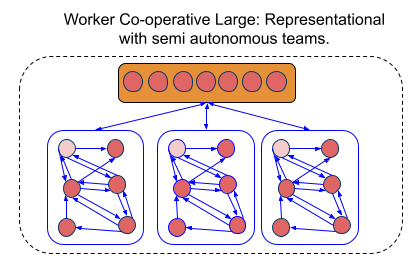

Hierarchy system
Usually this means a general manager is chosen; sometimes elected or specifically recruited/selected by the governing body.  They are accountable to the governing body, and have been given authority to manage the organisation. In larger co-ops there may be multiple levels of management. A term used for this relationship is; "Management is not a status but a function"


Even larger structures
Suma is the largest worker co-operative in the UK with around 130 employees.  They operate on an equal pay basis and don't have a CEO or executive managers in the normal sense of the term.  They also multi-role; which means members work in a least two different "Function Areas" of the Business.

Suma is governed by periodic General Meetings for all the membership, and an elected Board of Directors. On the Management side; the business is divided into "Function Area" Such as: Buyers, Warehouse, Drivers etc.  

These like the above operate relatively autonomously with each area having a "Functional Area Co-ordinator" who are elected to co-ordinate an area and come together with other "FACs" to co-ordinate operations as a whole.
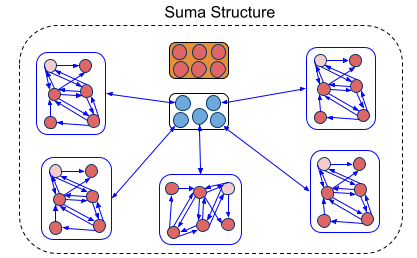


Suma is the largest using this structure, and there are a lot of interesting theories about democratic management and social relationships (how far can you go). One theory is Dunbar's number:

"A theoretical cognitive limit to the number of people with whom one can maintain stable social relationships...[1] This says that numbers larger than the Dunbar number generally require more restrictive rules, laws, and enforced norms to maintain a stable, cohesive group. No precise value has been proposed for Dunbar's number. It has been suggested it lies between 100 and 230, with a commonly used value of 150.[2 "

It might be no co-incidence that Suma has reached this size.  Is there a natural size for a worker co-operative? What should a worker co-operative do it if wishes to retain a democratic management structure but grow beyond 150? One suggestion is for the co-op to divide or create off-shoots, forming "Consortia" Corporate Group Structures of smaller co-operatives that share common approaches, branding and inter-trade with each other.

Mondragon
Some might say the Pinnacle of worker co-operative achievement is Mondragon in Spain. Governance and Management in Mondragon is very different to UK worker co-operatives; for a start it employs 85,066 people! It also has a very standard management hierarchy (although there are maximum pay ratio's and most managers are trained from within).

Mondragon is not like a traditional PLC either and operates more like an Economy in itself.  Mondragon is a type of Consortia mentioned above, where its member co-ops have their own bank, social security, education, research and development services.  All the 250+ businesses are split into Group; Divisions; Units. Each individual company is semi-autonomous and may leave the Mondragon Group (and some have).

Modragon's Governance is also on a representative system with workers voting for Board Members of their individual company, who in turn vote for the next level up

This below diagram illustrates one companies relationship to the overall structure.


Further Reading
Durbar's Number
Difference between Management and Governance
http://www.uk.coop/simplyseries 

16 June 2011

Worker co-operative election results 2011

Thank you for all those members voting, we can now publish the results of the worker co-operative council elections 2011. The results are:

Candidate
Organisation
No of votes
Britta Werner
Unicorn Grocery
237
Richard Crook
Essential Trading Co-operative
203
Edward Russell
Co-operative Web
175
Athene Ellana Richford
GreenCity Wholefoods
121
Steven Glynn
Sustainable Change Cooperative
114
M J Ray
Turo Technology LLP
64

Voter turn-out was 21% and I would like to congratulate Britta and Ed for being re-elected and Richard and Athene who will be new members of the Council.  They will join members not up for election this year:

Alison Banton, Dulas
Bob Cannell, Suma Wholefoods
Sion Whellens, Calverts

The next council meeting will take place on Friday 25th June at Congress in Birmingham. So if you would like to talk to your new and existing representatives please come along to Congress and Co-operatives UK's AGM.